Shader Library · Last updated May 2026

73 Shaders You'd Actually Use

Curated, not cataloged. Every RenderWave shader is hand-tuned, Metal-compute optimized, and tested on real club rigs. RenderWave's 73 shaders are production-grade kernels — not a 300-piece community catalog. Each one hits 4K60 on M2, exposes per-band audio modulation, and hot-reloads from a .metal file save.

14-day full-access trial. Card required. Cancel before day 15 and you will not be charged.

73
shaders
7
categories
4K60
M2 target
Hot
reload
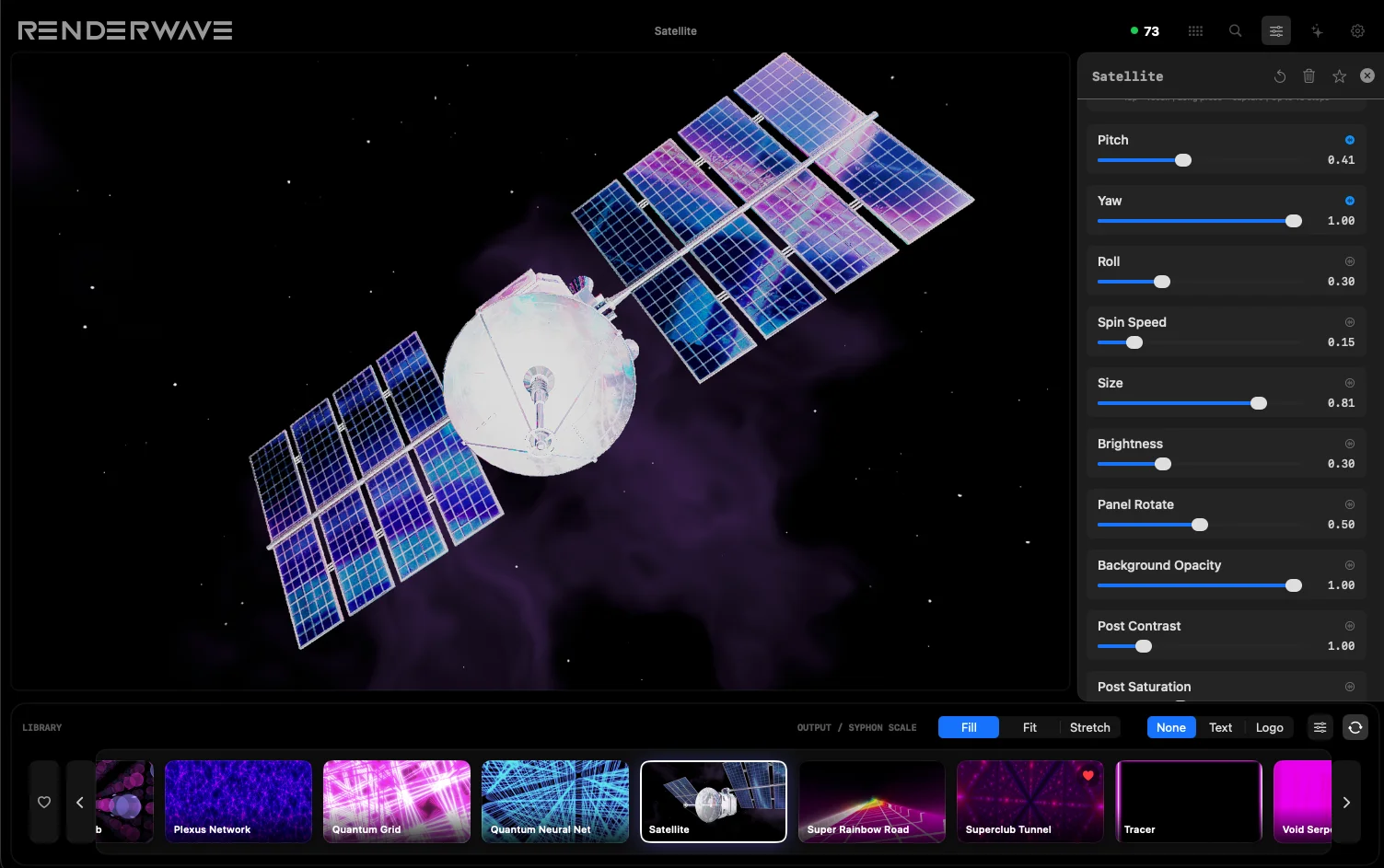
RenderWave Create Mode showing a Metal-compute shader preview with audio-modulated parameters

Philosophy

Quality over quantity.

There's a reason RenderWave ships 73 shaders instead of 316. When a catalog grows past a couple hundred pieces, the average quality drops fast. Most of those shaders never make it onto a real club rig — they look great in a static thumbnail, then stutter under load, fight the audio analyzer, or break when you push them to 4K. A library full of "yes that one too" entries makes you slower in front of an audience, not faster.

Every RenderWave shader has a production budget behind it. We write the Metal-compute kernel, then we audio-test it on real tracks across techno, house, drum & bass, and ambient. We tune parameter ranges so a MIDI knob sweep always lands on a usable look. We benchmark each kernel against a 4K60 performance budget on M2 — if it can't hold the frame, it gets rewritten or it doesn't ship. Each shader is a deliberate piece of work, not a checkbox.

The architectural decision underneath this is Metal-compute, not ISF-interpreted. ISF is a great open format, but it's interpreted at runtime over OpenGL or a Metal compatibility layer. RenderWave's kernels are direct MTLComputeCommandEncoder dispatches authored against the Apple Silicon GPU. That means lower latency, lower power draw, and headroom to stack effects without dropping frames.

The per-band audio modulation is the other half of the story. A library where every shader has been tested with bass / mid / treble routing is more useful than a library twice the size where half the shaders don't react well to a kick. The 73 here all do.

The library, organized.

Ten manifest categories, 73 shaders. The library is grouped by the same categories shipped in the app manifest, so this page mirrors the current Create Mode catalog instead of preserving old placeholder buckets.

Abstract

13 shaders

All tiers

Fluid color fields, vortexes, scanners, and dark-room texture tools.

  • Abyssal Vortex
  • Blinder
  • Chromatic Vortex V2
  • Cyber Hive
  • Dimensional Rift
  • Feathered Scanner
  • Liquid Chrome
  • Mandelbrot Zoom
  • Phantom Sigils
  • Plasma Pool
  • Plasma Pool 2
  • Tracer
  • Void Serpent

Circuit

2 shaders

All tiers

Networked, neural, and signal-grid looks for machine-room sets.

  • Hivemind Lattice
  • Quantum Neural Net

Fluid

2 shaders

All tiers

Liquid, chrome, and bioluminescent surfaces tuned for slower motion.

  • Bioluminescent Abyss
  • Liquid Chrome V2

Fractal

2 shaders

All tiers

Recursive mandala structures for long-form evolving visuals.

  • Fractal Mandala
  • Fractal Mandala V2

Geometric

33 shaders

All tiers

Lattices, grids, kaleidoscopes, tesseracts, city forms, and hard-edged mathematical structures.

  • Atomic Lattice
  • Audio React Ring V2
  • Cosmic Polyhedra
  • Crop Circles
  • Crystal Cavern
  • Crystalline Resonance
  • Data Lanes
  • Diamond Fields
  • Disco Lines
  • Flux Box Grid
  • Geodesic Web
  • Grid Chaser
  • Harmonic Mesh
  • Hyper Crystals
  • Hypercube Tesseract V2
  • Hypervortex Singularity
  • Infinity Mirror V2
  • Kaleido Flux
  • Matrix Rain 3D V2
  • Matrix Rain 3D V3
  • MEGALASERS
  • Monolith
  • Neon City
  • Neon Flux
  • Neon Tesseract
  • Neon Wave
  • Omni Geometry
  • Omni Geometry 2
  • Plexus Network
  • Quantum Grid
  • Super Rainbow Road
  • The Grid
  • Z IS FOR ZERO

Multipass

4 shaders

All tiers

Layered shaders with feedback, scanline, spectral, and multi-pass structure.

  • Pulse Conduit MP
  • Scanline Block Reactor
  • Spectral Fairway
  • Spectral Veil Engine

Organic

2 shaders

All tiers

Aurora-style motion and soft living fields for transitions and breakdowns.

  • Aurora Flow V2
  • MEGAURORA

Particles

2 shaders

All tiers

GPU-driven particle columns and constellation-style point systems.

  • Explosion Column
  • Neural Constellation

Space

8 shaders

All tiers

Black holes, galactic cores, satellites, and deep-space VJ surfaces.

  • Black Hole
  • Futurama
  • Galactic Core
  • Galactic Core V2
  • Rafale F3
  • Satellite
  • Void Stream
  • XOR Circles

Tunnel

5 shaders

All tiers

Forward-motion tunnel tools for techno, house, and high-energy room resets.

  • Chromatic Vortex V3
  • DOWNSPIRAL
  • MEGAGRID
  • Superclub Tunnel
  • WOOKIN OUT

Shader names shown here mirror the current app manifest. The RenderWave Create Mode picker remains the authoritative in-app surface.

How Mac VJ shader libraries compare

Counts come from each vendor's own marketing. Curation and quality are judgement calls based on published library samples and community feedback. Re-checked May 2026.

RenderWave

Curated
Count
73
Curated
Yes — every shader hand-tuned
Metal-compute
Metal-compute native
3D
Spatial looks across Space / Geometric / Multipass
Avg quality
Production-grade

Ghost Arcade

Count
316+
Curated
No — community catalog
Metal-compute
ISF-based
3D
Limited
Avg quality
Variable

VDMX (with ISF library)

Count
1000+ via ISF
Curated
No — open library
Metal-compute
Metal port over OpenGL pipeline
3D
Via third-party ISF
Avg quality
Variable

Synesthesia

Count
Scene library (not shader-counted)
Curated
Curated scenes
Metal-compute
Cross-platform engine
3D
Some 3D scenes
Avg quality
Production

Magic Music Visuals

Count
Module library
Curated
Modular building blocks
Metal-compute
Cross-platform engine
3D
Module-based
Avg quality
Generative

Ghost Arcade's "316+" figure is from its public marketing materials; VDMX library size depends on the user's installed ISF set.

Architecture

Metal-compute, not ISF-interpreted.

ISF (Interactive Shader Format) is a wonderful open standard — it gave the VJ world a portable shader format and an enormous community library. But it's a JSON-described GLSL fragment shader, executed by a host that often runs OpenGL or a Metal compatibility translation. The host pays for parsing, parameter binding, and context-switching every frame.

RenderWave's shaders skip that entire layer. Every kernel is a Metal compute function authored against the Apple Silicon GPU directly. The runtime hands the kernel zero-copy access to the previous frame, the audio analysis buffer, the parameter uniforms, and the output texture. There's no interpreter, no JSON, no GLSL-to-Metal pass.

Concretely, the dispatch loop looks like this:

// Per-frame, per-shader dispatch (simplified)
let encoder = commandBuffer.makeComputeCommandEncoder()
encoder.setComputePipelineState(shader.pipeline)
encoder.setTexture(prevFrame, index: 0)
encoder.setTexture(outputTexture, index: 1)
encoder.setBuffer(audioBands, offset: 0, index: 0)   // bass / mid / treble
encoder.setBuffer(paramUniforms, offset: 0, index: 1)
encoder.dispatchThreadgroups(grid, threadsPerThreadgroup: tg)
encoder.endEncoding()

The pipeline state is built once at load and cached. Parameter changes from MIDI, audio, or the sequencer write into a single uniform buffer — they don't trigger shader recompilation. The kernel reads the audio bands as a tiny structured buffer, not as global state. That's why per-band audio reactivity stays cheap even with eight effects stacked on top.

The practical result for VJs: RenderWave can hold 4K60 with the audio analyzer running, MIDI feedback active, Syphon output enabled, and three post-processing effects chained. ISF-based hosts on Mac can match the look — they just need more GPU headroom to do it, which means less budget for other effects in your stack.

Audio

Per-band audio modulation, on every shader.

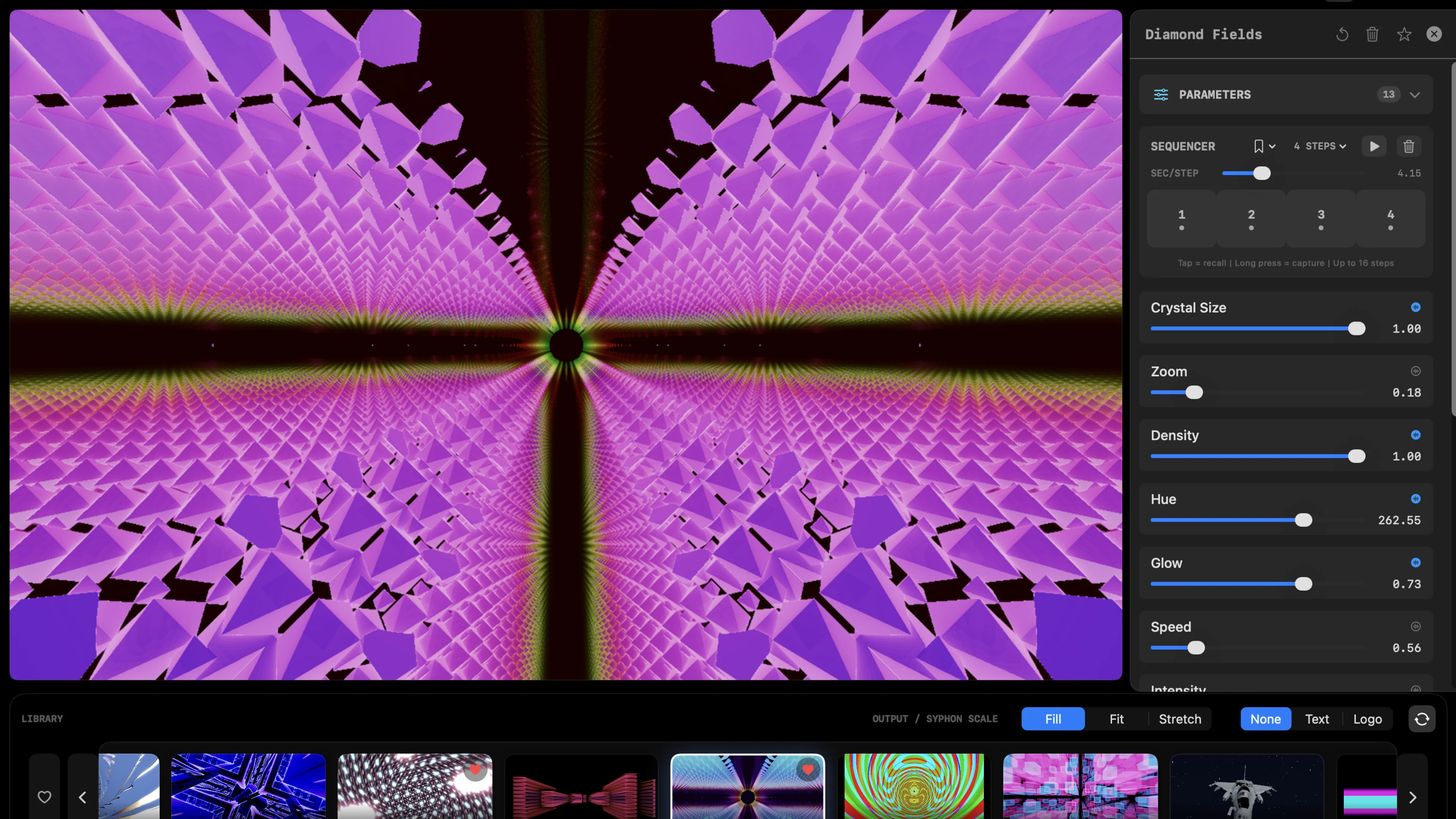
A lot of audio-reactive shader libraries hand you a single "loudness" value. That's enough for a strobe — it's not enough for a club set. RenderWave's audio engine runs an FFT on the live input and splits the spectrum into bass, mid, and treble bands with adjustable crossover frequencies. Each band is exposed to every shader as a separate value.

That means a tunnel shader can have its camera speed driven by bass while its color shift is driven by treble. A particle emitter can spawn from mid-band hits while its size pulses to the kick. A distortion shader can stay quiet during breakdowns and slam during the drop. You're not modulating a single global parameter — you're routing three independent envelopes into the kernel.

Each parameter slot has its own modulation depth, smoothing time, and response curve. Combine that with the modulation envelopes from the sequencer and the MIDI-mapped knobs, and every shader becomes a fully playable instrument rather than a fixed loop.

Author

Hot-reload your .metal files.

RenderWave watches the shaders directory at runtime. Save a .metal file in your editor — Xcode, VS Code, vim — and the change shows up on stage in under a second. No app restart, no project reload, no breaking the show.

Custom shaders pick up the full parameter system: bass / mid / treble routing, sequencer envelopes, MIDI-mapped knobs, and the same hot-reload pipeline the built-in 73 use. The format will be documented as the open shader-pack spec.

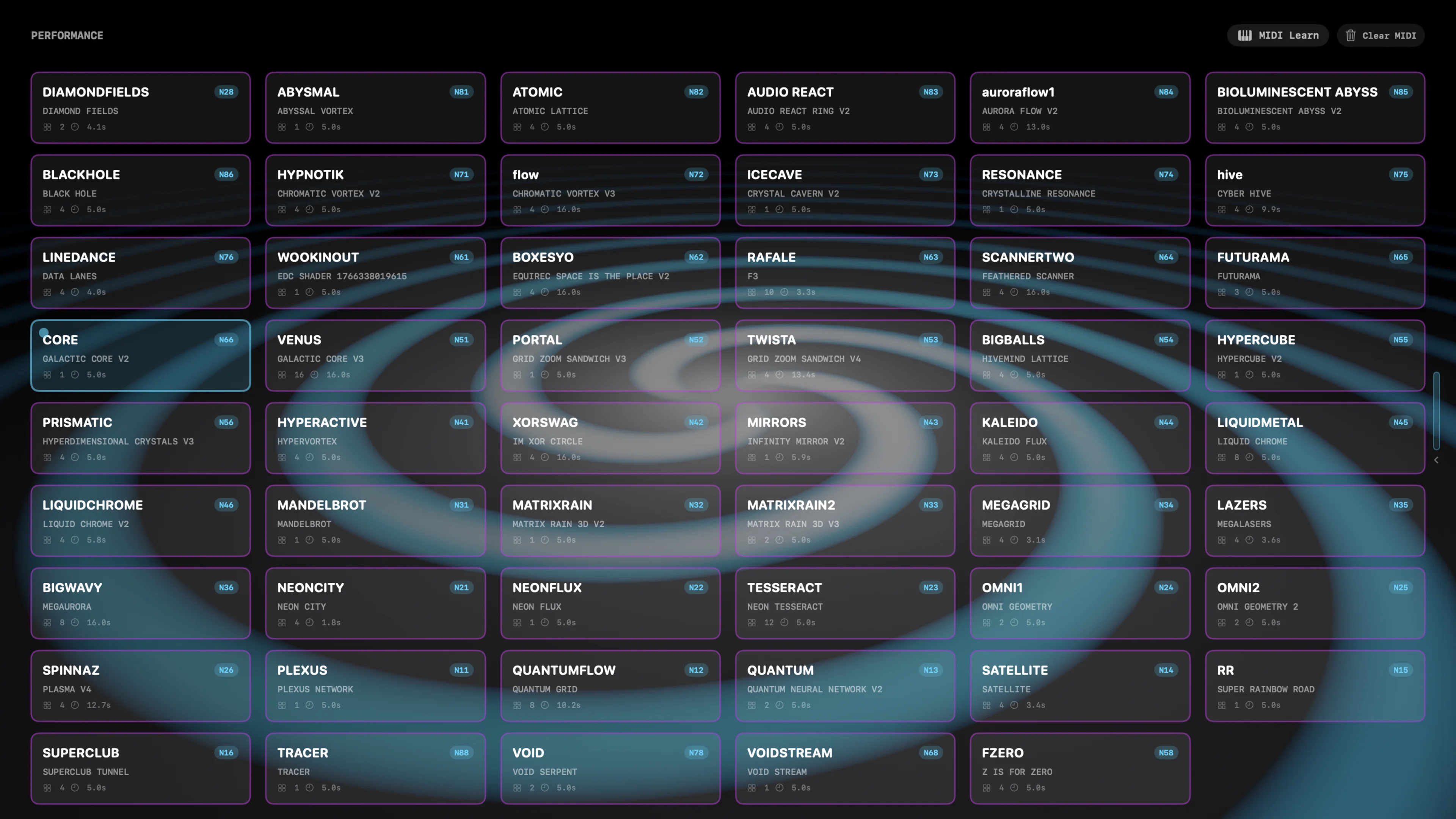
RenderWave shader output rendered in Performance Mode

Try the full shader library free for 14 days.

All 73 shaders. All ten manifest categories. Full per-band audio routing and hot-reload access. No reduced library, no watermark during the trial.

Card required for the trial. Cancel before day 15 and you will not be charged.

Shader library FAQ

The questions VJs ask before committing to a shader engine.

How many shaders does RenderWave have?

RenderWave ships with 73 production-grade Metal-compute shaders. Every shader is hand-tuned for Apple Silicon, audio-modulated, and club-tested for real-world VJ use.

Are RenderWave shaders open-source?

No. RenderWave's shaders are proprietary, hand-tuned for Apple Silicon Metal-compute. We're publishing an open shader-pack format on GitHub for community contributions.

Can I import ISF shaders?

ISF import support is on the roadmap. RenderWave's runtime currently expects Metal-compute kernels; an ISF translation layer is planned so VDMX users can bring their existing library.

Can I write custom shaders?

Yes. RenderWave's hot-reload pipeline watches .metal files; save your edits and they reload mid-show. The full parameter system, per-band audio routing, and modulation envelopes are exposed to custom kernels.

How does RenderWave's shader count compare to Ghost Arcade or VDMX?

Ghost Arcade's 316+ shaders are community-cataloged with variable quality. RenderWave curates 73 for production reliability and club performance. Every RenderWave shader hits 4K60 on M2 or better and ships with full audio-band routing and parameter automation.

Do shaders work at 4K?

Yes. Every shader in the RenderWave library is performance-tested for 4K60 on Apple Silicon M2 or newer. Heavier geometric, space, or multipass shaders may need more headroom on entry-tier hardware.